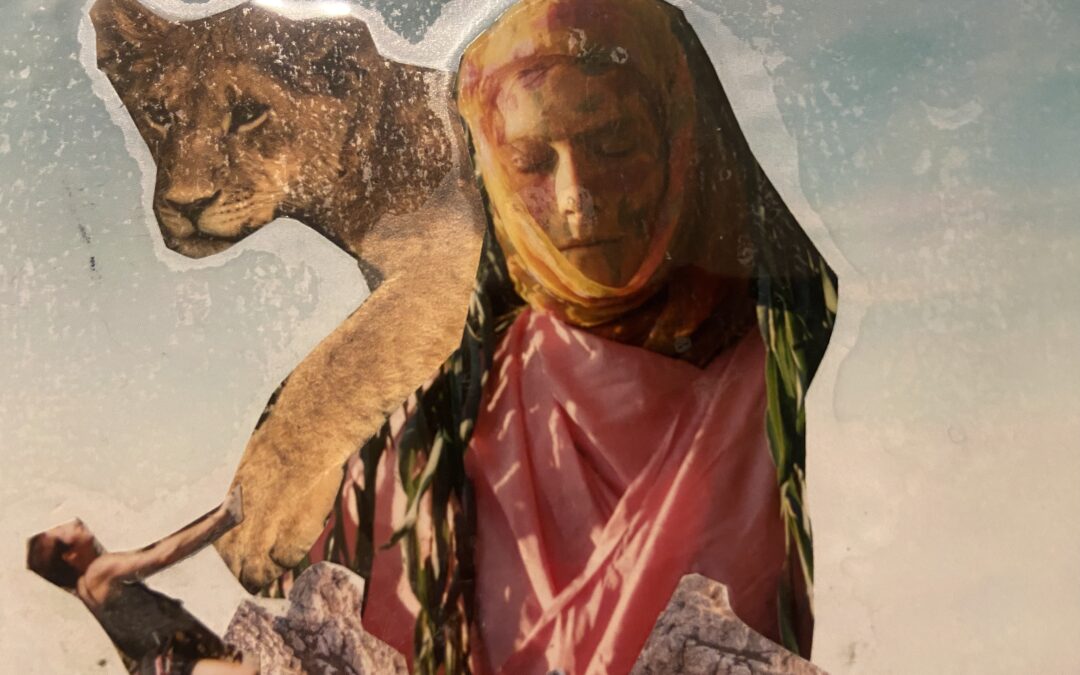

My inner museum

My inner museum

To change our mode of action, we must change the image of ourselves that we carry within us. — Moshe Feldenkrais

In my twenties, I worked part-time as an attendant in the municipal museum in The Hague.

My job was simple: keep an eye on the paintings.

There was a hall dedicated to the work of Piet Mondrian. Painting after painting, the whole wall filled with his geometric world — and then, in the middle of it all, a large canvas called Evolution.

Blue. The most extraordinary blue. Blue in the blue, layer upon layer, that draw me to other places...

I stood in front of it and forgot everything — time, space, my body, the other paintings I was supposed to keep an eye on.

Moments like that made me wonder how attention shapes our lives. What happens when one experience grabs our attention so completely that, for a while, everything else fades into the background?

As we live life, we have many experiences that hurt us, scare us, give us joy, love,… And as we grow, they become the stories of our lives, the paintings in our inner museum.

All of it is there, on the walls of the museum we carry inside us.

And in every museum, there is always one painting that captures the attention more than the others.

Mine was a classroom in the Netherlands: a little girl with buck teeth, spiky hair and a fiery red blush on her cheeks. The teacher making fun of her, the other children jeering at her.
And the girl — I can still see and feel her so clearly, standing in the front of the class — looking at herself from the sidelines as she cringes and slowly disappears.

For a long time, that was the only painting I could see.

I stood very close to it. So close that it filled my entire field of vision. Every thought, every movement, every glance in the mirror passed through the lens of that image — of a girl who was wrong in some fundamental way, who didn't belong, who was better off making herself smaller, invisible and less.

Over time, as this inner painting kept my attention,  I felt more anxious, more tense, and more alone.

The body learns quickly. Mine learned to hold itself in a way that matched the painting: tense, contracted, on guard, eyes that continuously scanned their surroundings for danger. A body telling the world, before any words were spoken, that it was bracing for something.

What happens when one painting fills the whole wall

When attention is drawn to one painting for long enough, the rest of the museum gradually disappears from view.

The other stories — of joy, of capacity, of connection, of the moments when life felt genuinely good — are still there on the walls. They have always been there. The body keeps them all.

And yet a nervous system, organised around a particular storyline, keeps returning to the same painting – in search for ‘the danger’, in search for confirmation of what it already knows. Moving through the world as if that painting were the only thing that existed.

The body moves accordingly. We may brace ourselves, clench our jaws, tense our shoulders, breathe shallowly. Little by little, the whole system becomes organised around the story that has come to occupy so much of our attention.

Zooming out

When attention has been drawn to one difficult painting for a long time, it can be surprisingly nourishing to discover another one that has been hanging there all along.

The more experiences the body has, the less it has to organise itself around a single story.

Dancing and moving with awareness invited my attention to other paintings in my inner museum.

Through experiencing different ways of moving, sensing and holding myself, I gradually discovered different ways of being. I began to discover paintings I hadn't noticed before. Paintings that evoked ease, joy, curiosity, confidence, connection.

My body encountered experiences it had no reason to defend against. And little by little, my attention was no longer drawn to just one story.

As my body gathered more ways of experiencing itself, I began to perceive my whole inner museum.

With that came a greater variety of sensations, emotions, and possibilities. Feeling more of myself allowed me to see myself differently, to perceive the world around me differently and to make different choices—choices that felt more in tune with who I am, what matters to me, and how I wanted to meet life.

The difficult painting is still there. It is now simply one painting among many.

From this new place, something shifted in the way I experienced myself, and with it, the way I held myself and moved through the world.


Muscle, Movement & Menopause: A Living Conversation

Muscle, Movement & Menopause: A Living Conversation

During menopause, as estrogen and progesterone decline, the body begins to change both hormonally and also in how strength, tone, and responsiveness are experienced. Strength may feel less present, and the body may ask for more rest between activities, sometimes needing shorter periods of activation.

Your muscles and your sense of responsiveness

We all carry two main muscle fibre types—slow-twitch and fast-twitch. Slow fibres support endurance and steady effort, while fast-twitch fibres are responsible for quick response, power, and reflex. During menopause, as hormonal regulation shifts, these fast-twitch fibres often become less readily available. These are the fibres that help you catch yourself, respond with ease, and feel agile and alive in your body.

Estrogen and progesterone also play supportive roles in the background of muscle health. Estrogen helps the body repair and recover after effort, while progesterone supports the body’s ability to soften and release tension by lowering muscle tone. As hormonal levels shift, recovery can take more time, and tension may linger more easily in the system.

Why you may feel your energy differently now

There is another layer underneath this: the small energy systems inside your cells, called your mitochondria. Muscle tissue holds many of them. When muscle mass decreases, there is also a reduction in overall energy availability. This can be felt as less stamina, less ease in sustained effort, or a system that depletes more quickly.

Muscles are part of a lively conversation between internal movement, organs, energy systems, the nervous system, and emotions. When muscles are functioning well and in balance, there is a greater sense of vitality, clarity, and inner steadiness. When they decline, the whole system feels it as reduced ease, capacity, and safety.

This shift in muscular capacity also influences how the nervous system organizes safety, regulation, and response.

When the body feels less strong or responsive, the nervous system can shift into a more protective mode. Through the HPA axis—the body’s stress regulation system—stress hormones such as cortisol may rise more easily, and the system can become more alert, sensitive, or on edge. Without the same hormonal cushioning and with less felt capacity to recover, the body may interpret everyday demands as requiring more effort than before

You may feel less trust in yourself and doubt yourself more. What was present can get amplified when the system is under strain. The inner critic may roar more strongly: you are not enough. You may feel more easily overwhelmed, or less able to meet what life asks of you.

In this way, your psyche follows the messages of the body: as internal capacity shifts, so does your sense of self and your perception of the world.

This can also shape how life is met. When internal capacity feels reduced, engagement with the world becomes less spontaneous—more careful, more effortful, less fluid. The system naturally prioritizes protection over openness, as if it is saying: I need more support to stay safe and steady.

Meeting your system where it is

As you begin to meet your system where it is, through your attention, movement choices, and how you are with your body, capacity can be restored.

As strength, coordination, and vitality improve, the nervous system begins to shift to: I can respond. I can be flexible. I can embrace life as it comes.

Movement that supports your system in different ways helps restore capacity. To meet life with resilience and vitality, the body and nervous system need movement variation. This allows them to reorganise, adapt, maintain muscle mass and healthy flow. This becomes especially important during menopause.

How my movement practices fit into this conversation

In my retreats, movement plays an important role in meeting your body, your nervous system, and opening to the many facets of who you are. Movement here is guiding, nourishing, and explorative across all layers of your being.

NIA Move to Heal naturally supports embodied vitality. It offers a variety of movement that nourishes strength, agility, flexibility, mobility, and coordination, while also supporting nervous system responsiveness and emotional regulation. It includes short, well-dosed bursts of strength and resistance, supporting the faster, more responsive muscle fibres that benefit from clear, focused activation.

The Feldenkrais Method refines how movement is organized through the nervous system. It improves coordination between muscles, so that unnecessary effort is reduced and movement becomes smoother, more integrated, and less effortful.

Together, these practices help restore communication between the nervous system, muscles, skeleton, senses, and emotions. Energy is used more efficiently, and movement becomes more fluid, responsive, and attuned to what your system needs in each moment.

Movement becomes a way of coming back into relationship with yourself and life, moment by moment. In this ongoing conversation, there is more listening, responsiveness, and room to simply be in your body with trust and ease and experience a more lived vitality.

The law of reciprocity in self care

The law of reciprocity in self care

What you give to your body is what your body gives back to you.

In both psychology and neuroscience, the law of reciprocity teaches us that our inner attitude and how we behave toward our bodies and ourselves is reflected back to us by our bodies by creating a feedback loop between our behavior and our biological well-being.

If you are often hard on your body, speak harshly to it, neglect its needs, or if you lack understanding of your body´s way and force it beyond its capacity, Your body can respond to this with tension, stiffness, contraction or fatigue, to name but a few sensations.

When this is a recurring pattern, it may even happen that the increase in intensity exceeds the bandwidth of your nervous system and body to digest life. resulting in your system becoming stuck in its defense mechanism. Your body may respond by becoming chronically tense, which can lead to hypervigilant attention habits, a limited ability to process life, anxiety, physical tension, constriction, gut stress, and low energy levels.

Why?

This response of your system has a direct effect on how it interprets signals from your external environment. Your movements are connected to your sensory perception and your interaction with your environment.

We are often unaware that we are acting out of tune with the subtle needs and desires of our biology. Many of us learned from a very young age that it is normal to force ourselves to do more than our body and nervous system can handle. We have learned not to live in harmony with our body and its rhythms by controlling and forcing it. We have learned that our body's reaction to our demands is a fault of our body. We have learned to silence those body's messages through quick fixes and external interventions. This behavior often leads to ways of holding ourselves, moving, expressing, breathing, or eating that are not in alignment with the nature and needs of our bodies.

And that is where the law of reciprocity can teach us to make a different move.  The law says that when you use effort, friction, and force to make your body do something against its will, your biology and nervous system respond with equal friction, tension, contraction, and an increasing intensity of negative sensations, emotions, images, and thought streams. On the other hand, when you follow your body's way and attune to its needs, your body and nervous system respond with a corresponding expansion, pleasant sensations and emotions, growth, ease, and fluidity.

And the needs of your body and nervous system are very down-to-earth. They need ongoing sensory contact with the outside world, and a reciprocal relationship with gravity. They need to follow their natural pace and rhythm. They need energy-efficient ways to go through life, which translates into sufficient rest, calm eating and digestion, and efficient, effortless movements, guided by feelings of ease, pleasure, and flow.

Would you like to bring more ease, pleasure, and flow back into your body and life?

All my neuro-somatic retreats are designed to help you reconnect with the needs and desires of your system and experience a lasting sense of wholeness and well-being.

Mirror, mirror on the wall 

Mirror, mirror on the wall 

Your body reflects your beliefs and images about yourself and the world.

The law of reciprocity, the social principle whereby an action is repaid in kind, also exists internally between our mind and body. The body mirrors the way we treat it, how we care for it, and how we think about ourselves through specialized brain cells called mirror neurons. Those neurons fire when we perform an action related to ourselves or our environment, and when we observe someone else´s action. They connect action to sensation and emotion, the language of your biology. Your brain does not distinguish between someone else's actions and your own actions. Your brain ‘mirrors’ those actions as if they come from a force outside yourself.

If you are often hard on your body, speak harsh words to yourself, neglect the needs of your body and soul, or if you do not understand your body's way and overburden it, your mirror neurons mimic that stress.
On the other hand, being kind to your body through care, appreciation, good nutrition, compassionate thoughts, and moving in tune with your body's natural pace, rhythm, and capacity can create a “mirror” that reflects a self-organizing system that radiates joy, vitality, inner peace, self-confidence, and self-compassion.

Here is the thing. We are often unaware that we are unkind to our bodies and behave in ways that are not in tune with them. We have unconscious beliefs and expectations, embedded in our culture, that we have grown up with and that have conditioned us not only in how and who we have to be but also in how we use and perceive our bodies and their rich language of emotions, sensations, and movement.  We may have internalised cultural beliefs that we are not good enough, that we must prove our worth by working hard, sacrificing our needs for others, dimming our light, or suppressing undesired emotions. Our body keeps that score. And here is the catch. This internal cycle of expectations and perceptions in your brain defines selfhood. How you “see” yourself in your mind determines how your body tries to look and organise itself to match your mental image.

What do you tell yourself?

Would you like to move those inner stories that are not serving your body and life?

My 7 Day dance healing retreat "Reclaim your Inner Freedom" is designed to help you move those stories that dim your sparkle and experience a lasting sense of wholeness and well-being again.

Renew your self-image to match who you really are?

Renew your self-image to match who you really are?

Very early on, our brains create an image of ourselves that has its roots in our earliest life experiences. Our brain uses this self-image as a kind of roadmap to predict who we should be and how we should be in relationship to our environment, and others. This self-image directs how we move, talk, think, feel, and perceive ourselves in the world. It drives our behavior and relationships, and it shapes our model of the world.

As toddlers, we learned by trial and error what was safe to feel and express in order to receive love from our caregivers. We learned to suppress certain sensations and copy certain behaviors for fear of rejection. In other words, we learn early on who, how, and what we need to be to belong and be safe.

A self-image is a complex composition of image, movement, emotion, sensation, and perception. Depending on how it sees us in the world, it forms attentional habits that then act as a filter, a kind of glasses, distorting all our perceptions, images, emotions, thoughts, and sensations. And all those perceptions, emotions, thoughts, and sensations inform our neuro-biology about what the world inside and around us is like.

So you could say that our self-image colors our inner experience and our perception of the outside world. If this keeps repeating itself, it creates patterns in our neurobiology that in turn affect our lives, relationships, and well-being.

Suppose you have a negative self-image...This can become an endlessly repeating circle that culminates in hypervigilant attention habits that revolve around what is wrong and constantly reinforce our negative experiences. Resulting in our neuro-biology running survival programs that deplete our body systems of energy. We might not feel very well in our skin all-together which in turn reinforces our negative self-image. An endless circle…

How can you create a new self-image that matches who you really are in the heart of your being?

Our body tells our story. It's like a history book. The way she stands, sits, moves, dances, and expresses inner movement. They are all expressions of how we are in the world and how we are in relationship with ourselves, and others. They also reveal how our nervous system has organized itself based on our self-image.

Our body also knows the way out of a negative self-image. That is out of neurobiological survival patterns rooted in negative attention habits. If we only dare to trust her and entrust us to her guidance, she will show us how to write a new story. A new story through the physical senses and how she receives the environment through them.

When we put our minds in the passenger seat and enjoy the ride of the eyes, ears, nose, tongue, and skin, we experience the world as it is. A world that is not necessarily about us. It's neutral and it helps our brains map themselves into the here and now that isn't colored by the attentional habits of our self-image. It gives our brain an accurate world map of the moment.

Our brain has the task of mapping out a route to the next moment that is as energy-saving, enjoyable, and pleasant as possible. This means that the brain makes a prediction and a strategy to face the future, the next moment. Our biology and body systems then use this information to do their magic. You can imagine that the uncolored objective reality of our senses provides a better roadmap for that route than the colored subjective negative world map created by the self-image.

And in time with the real-time roadmap of the senses and the updated strategies of our brain, our genius system starts to form a new self-image that is rooted in the here-and-now story of how we belong and are embedded in the greater web of life.

And then the circle starts again. Attention habits form that inform our biology which in turn informs us through how we move, feel, sense, give meaning, dream, and envision. Only this time the attention habits tell us about what is, and reflect our nature back to us by what we receive from the present world around us. And those will be messages of beauty, goodness, kindness, and ease that recalibrate our inner compass to our inner sparkle, to genuine well-being, and authenticity

And to have again an inner compass that guides us to our inner sparkle, to our north star, to the essence of who we are... That is what I wish for us all.

Muscle, Movement & Menopause: A Living Conversation

The power of your self-image

How do you feel? And how do you want to feel?

These are the most important questions for me when guiding someone. These questions led me to how a person experiences herself or her body and has created an image of herself. And for many women, that self-image is anything but positive, with all the misery that entails.

Our self-image is like a filter of thoughts, beliefs, and feelings through which we see ourselves, our bodies, our actions, and our environment. It has a huge impact on how we move through our lives, and what decisions we make for ourselves. It creates our signature as well as our habits.

Our self-image manifests itself in the body through the way we hold ourselves and the way we move. The more negative our self-image, the more postures we adopt that can really hurt us physically. Our self-image also reflects in the health of our body and in our outer appearance. Do you sparkle? Do you open your heart to the world or close yourself off? Do you feel heavy, rigid, or light, expansive? Our self-image guides us through life, for better and for worse.

I experienced first-hand how my self-image steered my life.
My self-image told me early on that it was not safe to be me, that I was not loved, not good enough and not worth being seen. That I should be ashamed of who I was and that I would never belong. And my way of coping with this image was by trying to be perfect in all sorts of ways and by doing that, I was actually creating more of a harmful self-image and its associated harmful habits. Do you recognise that your self-image makes you feel smaller and more scared than you actually are?

Our nervous system is very vulnerable in the early years of our lives. It absorbs energy from our caregivers and our environment. However, the brain is not yet sufficiently developed by then to understand and give words to all these stimuli. Until our 5th year of life, all life experiences, positive and negative, are experienced with the same intensity. Our nervous system at this stage explains all signals into pain or pleasure. As little ones, we are completely dependent on the love and attention of our caregivers to survive, so we will do anything to get it.

During this period, we often create the painful pieces of our self-image and all the emotional habits that stem from it. This limits us in our later life to step into our light. Our self-image has the power to hinder our nervous system from creating opportunities that put us in our power with regard to our health, our feelings, our thoughts and the way we move and act.

I know you need to change your self-image to get your sparkle back. And that this requires small actions. One step at a time. How wonderful that you can easily achieve this by starting through your body and at the level of action: namely, moving.

Movement is the language of the central nervous system.
That part of our nervous system that organises and coordinates our thoughts, feelings, actions, and movement. It receives all input through movements that take place inside and outside the body and that we experience through sensations, for example. Think of the movement of breathing, cell activity, the organs, the skin, the blood flowing through the veins, the beating of our heart, the life energy that flows through us and expresses itself through emotions, among other things, and so on.

With this information, our nervous system organises all the activities in our body. Not only our physical movement, but also our thinking, feeling, and acting. It has the ability to create endless new connections and opportunities to dance with life. And this is why, through the body and with movement, I can create lasting change for the women I coach.

May I dance you home?