
Renew your self-image to match who you really are?

Renew your self-image to match who you really are?

Very early on, our brains create an image of ourselves that has its roots in our earliest life experiences. Our brain uses this self-image as a kind of roadmap to predict who we should be and how we should be in relationship to our environment, and others. This self-image directs how we move, talk, think, feel, and perceive ourselves in the world. It drives our behavior and relationships, and it shapes our model of the world.

As toddlers, we learned by trial and error what was safe to feel and express in order to receive love from our caregivers. We learned to suppress certain sensations and copy certain behaviors for fear of rejection. In other words, we learn early on who, how, and what we need to be to belong and be safe.

A self-image is a complex composition of image, movement, emotion, sensation, and perception. Depending on how it sees us in the world, it forms attentional habits that then act as a filter, a kind of glasses, distorting all our perceptions, images, emotions, thoughts, and sensations. And all those perceptions, emotions, thoughts, and sensations inform our neuro-biology about what the world inside and around us is like.

So you could say that our self-image colors our inner experience and our perception of the outside world. If this keeps repeating itself, it creates patterns in our neurobiology that in turn affect our lives, relationships, and well-being.

Suppose you have a negative self-image…This can become an endlessly repeating circle that culminates in hypervigilant attention habits that revolve around what is wrong and constantly reinforce our negative experiences. Resulting in our neuro-biology running survival programs that deplete our body systems of energy. We might not feel very well in our skin all-together which in turn reinforces our negative self-image. An endless circle…

How can you create a new self-image that matches who you really are in the heart of your being?

Our body tells our story. It’s like a history book. The way she stands, sits, moves, dances, and expresses inner movement. They are all expressions of how we are in the world and how we are in relationship with ourselves, and others. They also reveal how our nervous system has organized itself based on our self-image.

Our body also knows the way out of a negative self-image. That is out of neurobiological survival patterns rooted in negative attention habits. If we only dare to trust her and entrust us to her guidance, she will show us how to write a new story. A new story through the physical senses and how she receives the environment through them.

When we put our minds in the passenger seat and enjoy the ride of the eyes, ears, nose, tongue, and skin, we experience the world as it is. A world that is not necessarily about us. It’s neutral and it helps our brains map themselves into the here and now that isn’t colored by the attentional habits of our self-image. It gives our brain an accurate world map of the moment.

Our brain has the task of mapping out a route to the next moment that is as energy-saving, enjoyable, and pleasant as possible. This means that the brain makes a prediction and a strategy to face the future, the next moment. Our biology and body systems then use this information to do their magic. You can imagine that the uncolored objective reality of our senses provides a better roadmap for that route than the colored subjective negative world map created by the self-image.

And in time with the real-time roadmap of the senses and the updated strategies of our brain, our genius system starts to form a new self-image that is rooted in the here-and-now story of how we belong and are embedded in the greater web of life.

And then the circle starts again. Attention habits form that inform our biology which in turn informs us through how we move, feel, sense, give meaning, dream, and envision. Only this time the attention habits tell us about what is, and reflect our nature back to us by what we receive from the present world around us. And those will be messages of beauty, goodness, kindness, and ease that recalibrate our inner compass to our inner sparkle, to genuine well-being, and authenticity

And to have again an inner compass that guides us to our inner sparkle, to our north star, to the essence of who we are… That is what I wish for us all.

When there is not enough energy for what you need

When there is not enough energy for what you need

What does your internal energy consumption look like?

There is a lot going on about energy efficiency and how to minimise high energy bills. We all have households with many energy-consuming appliances like smartphones, refrigerators, washing machines, lighting, and computers. We subscribe to an energy supplier for X amount of energy. Often, we don’t have to think about this because we only see the effects of our usage reflected in our bill. But every now and then we may face a shortage of power. The capacity has been reached and the power system says Nope. The demand for energy exceeds the amount of energy that can be supplied at that time.

Often it is quickly resolved by turning off a device. But what if we constantly run out of energy for the appliances we need to keep us warm, give us light, keep our food fresh? If a power outage lasted a long time, it would be disastrous for the food we keep in our fridge, for example.
We all have things that need to be permanently on like a fridge, things that only need electricity when we use them like lights and there are things we put on standby in case we need them like the television or an electric toothbrush. They may use a little energy instead of full power but they still take from the power net.

If our power grid capacity is exceeded, we need to look at what is really needed and where we can cut back by turning off appliances or using them at other times of the day. So outside, so inside!

What about the cost of your internal energy usage?

As living beings, we also consume internal energy generated by the energy supplier of our system. And it pretty much works the same as in our outside world. There are body systems that run in the background and need energy 24/7 to keep us alive: like our respiratory system, nervous system and brain, heart, immune system, digestive system, part of our motor system, and so on. There are body parts’ that we use consciously and often, such as our muscles that need energy to generate power to move, hold us upright, hold us together, speak, look around, hear, smell, eat, and express our emotional states. Like our mind that needs energy to think, and so on. And all these physical energy processes have to stay within a certain range for us to be on the safe end of survival.

One thing is certain, we cannot buy more capacity for our internal energy system. Each of us has a certain capacity available. So our system has to manage its capacity well to keep everything within a safe bandwidth. If we exceed that bandwidth, we risk an energy outage. And as you can imagine, that can be disastrous. Fortunately, our system then has a preservation system that kicks in as a measure of first aid. It is called the Freeze response and it preserves our energy currency ‘Oxygen’ by turning off all systems that do not pose an immediate threat to our survival when they are more or less de-activated, so that our heart and brain can continue to do their work. But the freezing system is not a solution for long-term excessive use because it uses precious energy blocking all body systems that cost energy and it does so without generating energy.

Ideally, our system should not need to resort to a freeze response on a daily basis. And ideally, we should not use large amounts of energy every day to fight or flee. Or do we? For many of us, the reality is that we live in a fast-paced, mind-oriented society with little regard for our nervous system and biological needs, resulting in chronic stress, mental pressure, and overwhelm. A day to day world where there is less and less time to nurture our soul, to rest, or for a warm-hearted, meaningful moment together, a refreshing walk in nature, or a dance, simply because it is so much fun to let loose for a bit.

How energy efficient is your system?

That said, imagine if an energy consultant came to your “home” to check your internal energy meter and look at the efficiency and sustainability of your internal energy consumption patterns? How high would your consumption be? Maybe just look at your movement habits, your attention habits and your emotional and thinking habits…

Are you working harder than you need to?
Are you constantly overthinking or worrying?
Do you experience a lot of intense emotions on a daily basis?
Do you experience a lot of stress in your day-to-day life?
Does the world feel like a dangerous place?
Do you rush through your days?
Do you spend hours sitting and looking at your screen?
Do you often tighten your shoulders and clench your jaw to hold yourself together? 
Or do you tighten your muscles to keep yourself upright?
Do you squeeze your buttocks and abdominal muscles together when you speak out? Or perhaps to look a certain way?
Do you metaphorically walk on eggshells and hold your breath to avoid conflict with others?
Do you try to push your physical limits when you exercise or do yoga? 
Do you often have muscle pain after working out?
Are you hard on yourself? Maybe a perfectionist?

Some of these questions may be easy to answer. Some may be about unconscious stress- and tension habits. Nevertheless, all of these habits and patterns in perceiving, moving, acting, thinking, and feeling lead to the depletion of your system’s energy budget. This can eventually make you feel stuck, flat, disconnected, fatigued, overwhelmed, and anxious in your daily life.

In the next blog, I’ll reflect a bit more on how our brain takes care of our internal energy budget and the ways it can become disorganised in the process.

Why a ‘step by step’ approach gives more results than a quick fix

Why a ‘step by step’ approach gives more results than a quick fix

I have never believed in quick fixes. Rapid changes often mess with our finely tuned system They undermine our natural rise and fall, resulting in overly intense highs followed by deep lows. We have probably all tried a Jo-Jo diet, where you ended up worse off than you started…

Quick changes usually throw us back into the tightest grip of our unhealthy habits and behaviours.

Rather, I advocate small, thoughtful steps that allow our system to try something new, like we take time to try on a new dress. It allows our system to move back and forth – to oscillate and also to reverse in any way it wants. It gives it time to test its ‘water’ again and again. So that it can make intelligent choices that serve our whole system in the most optimal way.

Perhaps it is that many of us need to learn to trust our Self-Wise again in choosing what is best in the given situation or how we can best heal or enhance our growth.
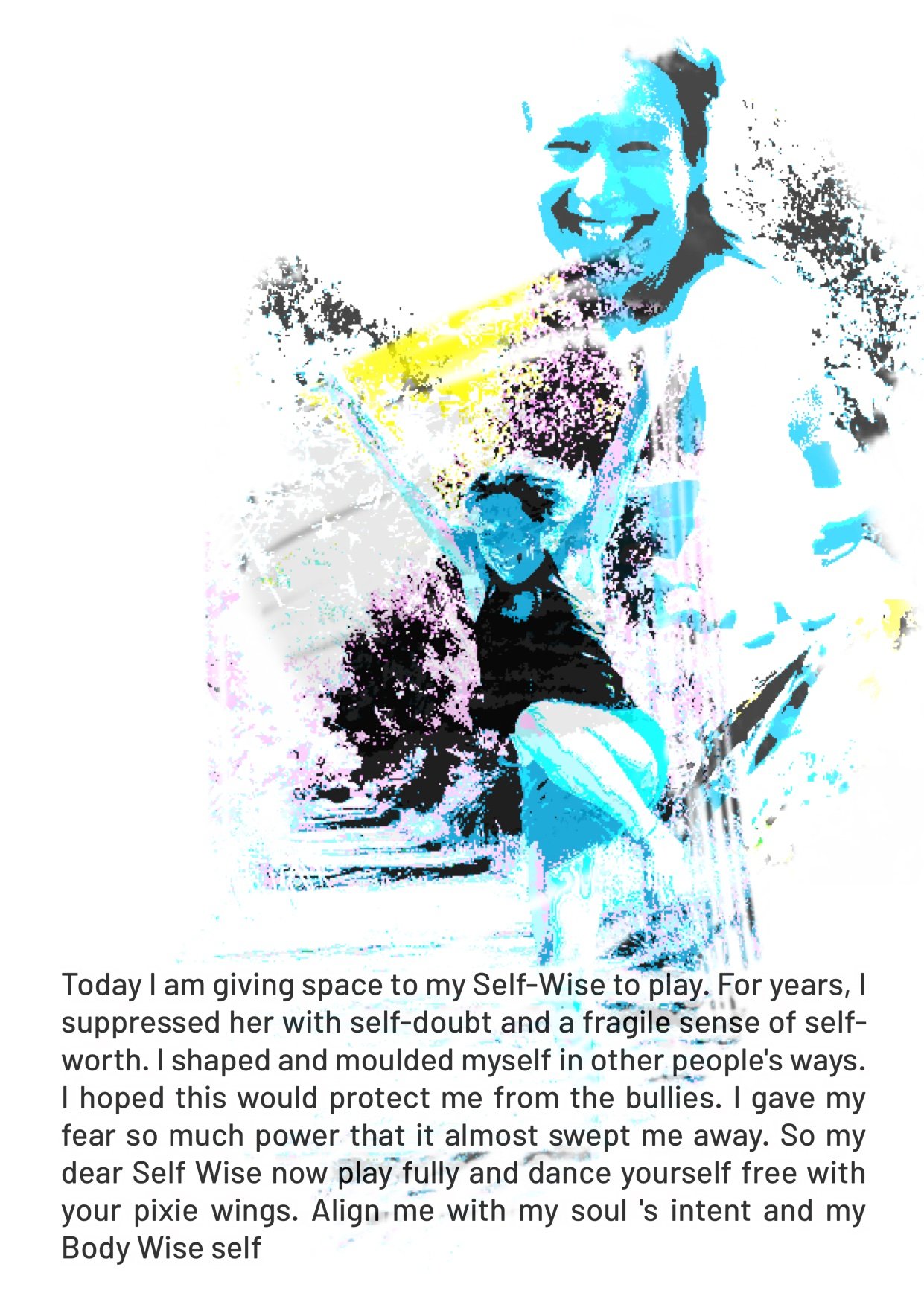
I call it giving your Self-Wise space to play. That means to explore, taste, pause, sense, feel, and do or undo in a relaxed, aware, and easy way.

Here is to your Self-Wise; your intelligent Body Wise Soul!
When was the last time you invited her to play? 

What moves you?

What moves you?

When it gets freezy underneath.

In 2021 I gave a presentation for the online Movement and Wellbeing Festival organised by Angela McMillan.

I gave a talk about ways to move “From freeze to flow” And as I was writing on my presentation, memories came to mind of childhood times when I struggled with fear, shame, and insecurity, unable to control my turbulent inner world that was constantly put on edge by being bullied and ridiculed. It resulted in a lot of uncomfortable physical sensations that I couldn’t control at the time. Eventually, I tried to get rid of them by dissociating myself from my body or somehow controlling it. Slowly, I slipped into a continuous, slumbering state of freezing. Not much later I developed an eating disorder, followed by other destructive numbing habits.

Freezing symptoms can linger just under the skin for long times keeping you from engaging in intimate connection with yourself and others. On the outside you may look like a happy puppy, people may praise you for being such a good listener, for being flexible, helpful or so loyal. But between the lines, suffering happens. It can manifest itself by withdrawing from situations and people, feeling very tired, lonely, and depressed, feeling chronically anxious in your skin, not knowing what you like, want, or don’t want, or what has meaning for you, having trouble concentrating and focusing, having trouble putting your money where your mouth is, or to get moving. Physically you can feel like you can’t hold yourself up, feeling tight, tense, and limp at the same time,  a lack of fluid movement and stability, or experiences of spatial unclarity, bumping into things, tripping, and hurting yourself.

Actually, we all experience freezy states on a daily basis.
Now more than ever! Many of us are living more in the head than in the body. Our smartphones keep us attached to the screen even when biking or crossing a road. Mental information forms the biggest part of our nowadays intake of information about our environment.

We live in an expectation- and performance-oriented society in which there is little room for spontaneity, authentic self-expression, or listening to the heart and senses. Many of our physical activities are about looking good rather than feeling good. Feeling present and alive in the body is not so obvious anymore. The pandemic certainly contributed to this disembodied life.

magic happens when you choose to follow flow

For a long time, I tried to work with the turbulent emotions themselves. It was yo-yo-ing between feeling okay and feeling down again. It took a toll on my health and made me feel less and less secure with myself. It was exhausting falling and crawling back up again and again.

Then by chance, I discovered the somatic movement approach of the Feldenkrais method. During the first session, I felt calm instead of cathartic. Just feeling good without having to go back into that dark hole first. Wow! As I continued to deepen my understanding of the Feldenkrais Method and other somatic-, and systems-oriented movement and dance approaches, I gained three very important insights:

  1. Where attention goes, energy flows
  2. Each of us is a living system, a complex fabric, of biology, energy, consciousness, and soul which are interrelated, interconnected, and interdependent.
  3. All living systems have an innate capacity for self-healing, thus so do we, if only we follow our system’s way of ‘thinking in relationships, integration, and interconnectedness’ instead of being a hierarchy divided into a mind, a body with parts, a soul and spirit.

I discovered how I had gotten stuck in a one-sided negative attention spiral of What’s Wrong. And I learned that thinking and emotions are only two channels of a huger somatic constellation through which we know ourselves, and by which a living system informs itself of inner and outer relationships. Most importantly I learned how to help my system prime for healing, nurturing all somatic information channels with the input of “What is. Through Perception, reconnecting with my senses, and learning systemically from the inside out through movement, and now-attention.

In many forms of therapy and coaching, the focus is on the somatic channels of emotion and thought only. The attention is on What is wrong; the former experiences, the trauma… Reliving the triggering emotions, and analyzing them. And I experienced that this starting point keeps reinforcing the pattern of suffering instead of helping our system to self-regulate and heal.

Leaving the old experiences and analyses alone for a while and spending time with my senses in the now, renewed my ability to feel pleasurable, comfortable, and easy sensations in my body. Sensations that invited me to stay in my body, feel safer in my body, gain trust in my being able to surf the emotional waves, and slowly create a greater capacity to deal with all of life, including former traumatic experiences.

It certainly didn’t happen overnight, no quick fix here. And that is exactly why the healing happened! Instead of forcing my system to suddenly change, I danced with the system through awareness, movement, stillness, and time, crafting my attention to what felt good. Gently offering options to my system, in addition to the one my system was used to. I learned to trust my system that it would choose what felt best to thrive in life in its own natural time and wisdom.

You can find my talk below:

In the Movement and Wellbeing Festival 2021 of Online Movement Academy, I shared a Feldenkrais somatic movement experience that has helped me and my clients to follow and flow with our systems and move from freeze to flow. You can listen and move with it below.

Better your foundation for more ease and support

by Pingel Braat

https://drive.google.com/file/d/1NecbplsqrwCUdYHeQ0X6q3zWegW64_I-/view?usp=drive_link

What if you could feel more ease and pleasure in your life?

What if you could feel more ease and pleasure in your life?

Feeling more wase and pleasure all starts with becoming aware of how you feel in your body!

How do you feel? And is that how you want to feel?

Most people’s sensation compass is tuned to pain. To feel pain, you need more pain. It’s a vicious cycle that puts you in a downward spiral. By realigning yourself with the smallest sensations of pleasure and ease, you can begin to realign your sensation compass. It all starts with a more curious, intimate, and caring relationship with your body.

By feeling into your body without immediately judging what you feel, you can reconnect with that inner wisdom and tap into the healing capacity of your system and its intelligence. Pleasure attracts more pleasure. In this video, I tell you more.